Outsourcing has become a cornerstone of modern business strategy, enabling companies to streamline operations, reduce costs, and access global talent.
Among the top outsourcing destinations, the Philippines has emerged as a leader, particularly for industries like SaaS, tech, real estate, and marketing.
With its cost-effective labor, highly skilled workforce, and strong cultural affinity with Western markets, the Philippines offers a compelling value proposition for businesses all over the world.
Related: AI-Empowered Outsourcing: How Virtua Solutions is Leveling Up For The Future
Outsourcing Pricing Models Matter
However, one of the most critical aspects of outsourcing success lies in understanding the pricing models available. Choosing the right pricing structure can make or break your outsourcing experience.
Virtua Solutions Outsourcing will walk you through the most common outsourcing pricing models in the Philippines, their pros and cons, and how to avoid hidden costs to make informed decisions for your business.
Common Outsourcing Pricing Models in the Philippines
Let’s look at the most common pricing models in the Philippines for the outsourcing industry. We will outline their definitions, pros and cons, as well as the best-case scenario for you as an outsourcing client.
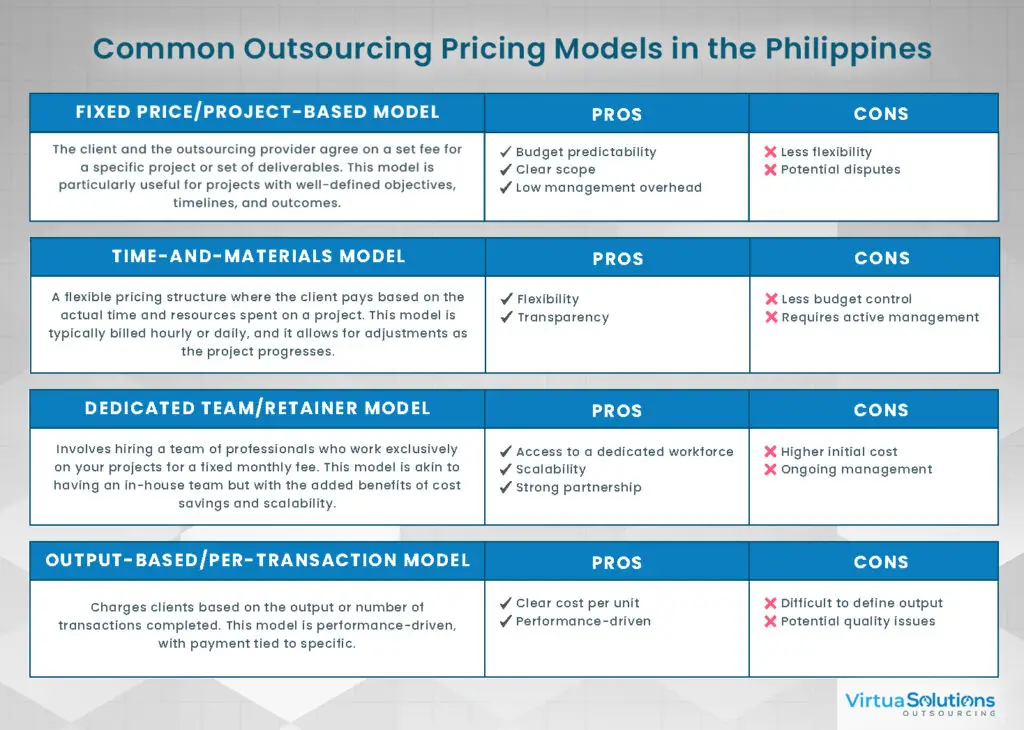
1. Fixed Price/Project-Based Model
The fixed-price or project-based model is a straightforward pricing structure where the client and the outsourcing provider agree on a set fee for a specific project or set of deliverables.
This model is particularly useful for projects with well-defined objectives, timelines, and outcomes. The provider takes on the responsibility of delivering the project within the agreed budget and timeframe, regardless of the resources or time required.
Pros:
✔️ Budget predictability: You know the exact cost upfront, making it easier to plan and allocate resources.
✔️ Clear scope: Both parties agree on deliverables, reducing ambiguity and ensuring alignment.
✔️ Low management overhead: The provider handles execution, freeing up your time to focus on other business priorities.
Cons:
❌ Less flexibility: Changes to the project scope can lead to additional charges, which may not be ideal for evolving projects.
❌ Potential disputes: Unclear requirements or poorly defined deliverables can result in disagreements, delays, or additional costs.
⭐ Ideal for: One-time projects like software development, marketing campaigns, or system migrations where the scope and deliverables are clearly defined.
2. Time and Materials (T&M) Model
The time and materials (T&M) model is a flexible pricing structure where the client pays based on the actual time and resources spent on a project. This model is typically billed hourly or daily, and it allows for adjustments as the project progresses. See: Outsourcing solutions custom-made to meet your needs.
It’s particularly suited for projects where the scope is not fully defined at the outset or where requirements are expected to evolve over time.
Pros:
✔️ Flexibility: Adaptable to evolving project requirements, making it ideal for dynamic or complex tasks.
✔️ Transparency: Detailed billing ensures you know exactly where your money is going, with clear breakdowns of time and resources used.
Cons:
❌ Less budget control: Costs can escalate if the project takes longer than expected or if additional resources are required.
❌ Requires active management: You need to monitor progress closely to avoid overruns and ensure the project stays on track.
⭐ Ideal for: Ongoing projects with changing requirements, such as software maintenance, creative design work, or research and development initiatives.
3. Dedicated Team/Retainer Model
The dedicated team or retainer model involves hiring a team of professionals who work exclusively on your projects for a fixed monthly fee.
This model is akin to having an in-house team but with the added benefits of cost savings and scalability. The team is fully dedicated to your business, ensuring a high level of focus and commitment.
Pros:
✔️ Access to a dedicated workforce: Your team is fully committed to your business, providing consistent support and expertise.
✔️ Scalability: Easily adjust team size based on your needs, whether you’re scaling up for a big project or scaling down during quieter periods.
✔️ Strong partnership: Builds long-term collaboration and trust, fostering a deeper understanding of your business goals and processes.
Cons:
❌ Higher initial cost: Requires a larger upfront investment compared to other models, as you’re paying for a full team.
❌ Ongoing management: You’ll need to oversee the team’s performance and ensure they align with your business objectives.
⭐ Ideal for: Long-term projects, ongoing support, or businesses looking to build a remote team for functions like customer service, software development, or back-office operations.
4. Output-Based/Per-Transaction Model
The output-based or per-transaction model charges clients based on the output or number of transactions completed.
This model is performance-driven, with payment tied to specific deliverables, such as per customer service call, processed order, or completed task.
It’s particularly effective for repetitive, high-volume tasks where output can be easily quantified.
Pros:
✔️ Clear cost per unit: Easy to track and measure ROI, as you pay only for completed tasks or transactions.
✔️ Performance-driven: Encourages efficiency and quality, as providers are incentivized to deliver results.
Cons:
❌ Difficult to define output: Not all tasks can be easily quantified, making this model less suitable for complex or creative projects.
❌ Potential quality issues: Providers may prioritize quantity over quality if not monitored closely, leading to subpar results.
⭐ Ideal for: Repetitive, high-volume tasks like data entry, customer support, order processing, or lead generation.
🎯 Straight from the Virtua Team:
What pricing model does Virtua use and why?
👉 We use Dedicated Team Retainer because we believe in outsourcing as a long-term solution to business challenges. Depending on the service model that the client avails, the monthly fee per team member includes a whole host of services from Virtua Solutions such as payroll, tax and compliance, training, etc.
What is Virtua’s guarantee of transparent billing and zero hidden charges?
👉In each invoice we issue to clients, there is a breakdown of charges and inclusions for the particular billing cycle. This ensures that the clients only pay for what they need. There is also a section in our contracts where we state this. |
Choosing the Right Pricing Model for Your Business
Selecting the right pricing model for your outsourcing needs is a critical decision that can significantly impact your project’s success, budget, and overall business outcomes.
The choice depends on several key factors, each of which should be carefully evaluated to ensure alignment with your goals and operational requirements. Selecting the right pricing model depends on several factors:
- Project Scope: Is your project well-defined or likely to evolve?
- Budget: Do you need fixed costs or are you comfortable with variable expenses?
- Flexibility: Will your requirements change over time?
- Risk Tolerance: Are you willing to take on more risk for potential cost savings?

Use case studies of pricing models based on business types and needs:
👉 A SaaS company launching a new feature might opt for a fixed-price model to ensure the project stays within budget and is delivered on time.
👉 A real estate firm needing ongoing lead generation might choose a dedicated team model to maintain consistent support and scalability.
👉 A marketing agency handling seasonal campaigns might prefer a time and materials model to accommodate changing creative requirements.
👉 An e-commerce business processing high-volume transactions might benefit from an output-based model to pay only for completed tasks.
Related: Managed IT Services: Getting MORE From Them With The Right Solution
Avoiding Hidden Charges and Ensuring Transparency
Hidden costs can derail even the most well-planned outsourcing strategy. At Virtual Solutions Outsourcing, we are fully dedicated to transparency. We don’t want our clients to be taken by surprise because of additional fees.
So we do our best to avoid them and keep our communication lines open with our clients. On your side, here are ways to avoid unexpected charges:
✅ Detailed Contract: Ensure all costs, including setup fees, management fees, and communication charges, are clearly outlined.
✅ Ask the Right Questions: Inquire about billing practices, potential additional costs, and how changes to scope are handled.
✅ Regular Reporting: Request detailed reports to track expenses and performance.
✅ Clear Communication: Establish open lines of communication to address issues promptly.

Building a Successful Outsourcing Partnership
Outsourcing is more than just a transactional relationship; it’s a strategic partnership that, when nurtured correctly, can drive significant value for your business.
A successful outsourcing partnership goes beyond cost savings—it fosters collaboration, innovation, and long-term growth. Here’s how you can build and maintain a strong, productive relationship with your outsourcing provider:
🎯 Set Clear Expectations
The foundation of any successful partnership is clarity. Define goals, timelines, and deliverables from the start.
Document these details in a comprehensive contract or service-level agreement (SLA) to avoid misunderstandings later.
Clearly define roles and responsibilities, communication protocols, and escalation procedures to ensure smooth collaboration.
For example, if you’re outsourcing customer support, specify response time targets, resolution rates, and quality standards.
If it’s a software development project, outline milestones, testing requirements, and acceptance criteria.
Clear expectations not only align both parties but also provide a benchmark for measuring success.
🎯 Foster Collaboration
Effective communication is the lifeblood of any outsourcing partnership. Establish regular touchpoints, such as weekly check-ins, progress reviews, or monthly performance meetings, to stay aligned and address any issues promptly.
Use collaboration tools like Slack, Microsoft Teams, or project management platforms to facilitate real-time communication and transparency.
Encourage a culture of openness where both parties feel comfortable sharing feedback, raising concerns, and suggesting improvements.
Treat your outsourcing provider as an extension of your in-house team, involving them in strategic discussions and decision-making processes where appropriate.
This collaborative approach builds trust and ensures that the provider is fully invested in your success.
🎯 Conduct Regular Reviews
Regularly evaluate the performance of your outsourcing partner to ensure they’re meeting your expectations and delivering value.
Use the metrics and KPIs defined in your SLA to assess their performance objectively. Provide constructive feedback and work together to address any gaps or areas for improvement.
Performance reviews also offer an opportunity to realign goals and priorities as your business evolves. For instance, if your company expands into new markets, you may need to adjust your outsourcing strategy to accommodate changing requirements.
Regular reviews ensure that the partnership remains aligned with your business objectives.
Related: SaaS Startup Business: The Onboarding Metrics That You Should Watch Out For
Making Informed Decisions for Outsourcing Success
Outsourcing to the Philippines offers unparalleled opportunities for cost savings, scalability, and access to talent. However, the key to unlocking these benefits lies in understanding the different pricing models and choosing the one that aligns with your business goals.
Whether you opt for a fixed-price model, time and materials, a dedicated team, or an output-based approach, careful planning and due diligence are essential.
By avoiding hidden costs and fostering a strong partnership, you can maximize the value of your outsourcing investment.
By understanding the nuances of outsourcing pricing in the Philippines, you can make informed decisions that drive growth and efficiency for your business. Whether you’re in SaaS, tech, real estate, or marketing, the right pricing model is out there—waiting to help you achieve your goals.
Ready to take the next step?
Contact Virtua Solutions Outsourcing today to explore how we can help you achieve your business goals through cost-effective, high-quality outsourcing solutions.
Related Resources: