For North American tech leaders, the decision between building an in-house team or partnering with an outsourced tech provider isn’t just about cutting costs—it’s about maximizing return on investment while maintaining quality and scalability.
As companies navigate tighter budgets and fierce competition for talent, understanding the true ROI of each approach has become critical to sustainable growth.
Related: Boost Your Marketing ROI: The Strategic Advantages of Outsourcing to Filipino Creative Talent
The Hidden Costs of In-House Teams
When calculating the cost of in-house teams, many leaders focus solely on salaries. However, the real expense extends far beyond base compensation.
In major North American tech hubs, senior developers command salaries ranging from $120,000 to $180,000 annually. But that’s just the beginning.
Factor in benefits (typically 25-30% of salary), office space, equipment, software licenses, training, and recruitment costs, and the total cost of employment often doubles.
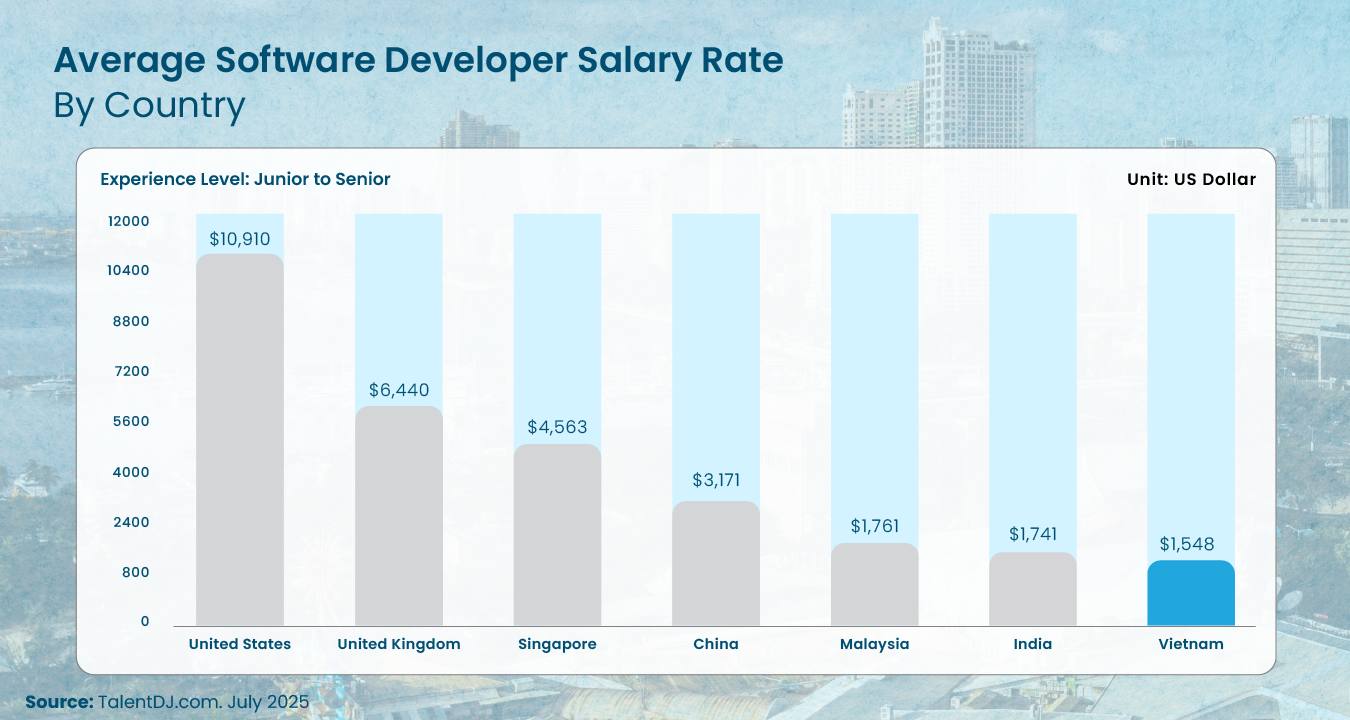
A $150,000 developer actually costs closer to $250,000-$300,000 when all expenses are considered. Then there’s the opportunity cost of lengthy hiring processes—often 3-6 months in today’s competitive market—during which projects stall and deadlines slip.
In-house vs outsourced tech decisions also involve less obvious expenses like management overhead, HR administration, and the risk of employee turnover.
When a key team member leaves, companies face not only replacement costs but also knowledge transfer challenges and project delays.
Related: Navigating Outsourcing Costs in the Philippines: A Guide to Pricing Models
The Economics of Outsourcing
North America outsourcing to regions like the Philippines offers compelling cost advantages without sacrificing quality.
Skilled developers in these markets typically cost 60-70% less than their North American counterparts while bringing comparable expertise and strong English proficiency.
But the outsourcing ROI extends beyond labor arbitrage. Outsourcing partners provide immediate access to established teams, eliminating recruitment delays and onboarding time.
They also absorb operational overhead—infrastructure, HR, training, and management—that would otherwise burden your internal resources.
Related: Best Practices for Onboarding and Managing Offshore Real Estate Marketing Teams
📌 Consider this scenario:
👉 A North American SaaS company needs a five-person development team.
❌ Building in-house might cost $1.5 million annually (including all overhead),
✔️ While a comparable outsourced team could deliver the same output for $600,000-$800,000.
💲That’s potential savings of $700,000+ per year that can be reinvested in product development, marketing, or market expansion.
Quality and Productivity Considerations
The outsourcing landscape has evolved dramatically over the past decade. Today’s leading outsourcing providers don’t just offer cost savings—they deliver specialized expertise and proven methodologies that can actually enhance productivity.
Established outsourcing partners have refined their processes through hundreds of client engagements. They bring battle-tested frameworks for project management, quality assurance, and team coordination.
Many maintain certifications in industry standards and invest heavily in keeping their teams current with emerging technologies.
Related: AI-Empowered Outsourcing: How Virtua Solutions is Leveling Up For The Future
The time zone advantage is often overlooked in ROI calculations. Teams in the Philippines, for example, can provide round-the-clock development cycles, potentially accelerating project timelines by 30-40%.
While your North American team sleeps, your outsourced team continues development, testing, and bug fixes.
Flexibility and Scalability Benefits

Market volatility demands agility. In-house teams represent fixed costs that persist regardless of project demands or market conditions.
Scaling up requires lengthy hiring processes; scaling down involves painful layoffs and potential legal complexities.
Outsourced teams offer dynamic scalability. Need to ramp up for a product launch? Your outsourcing partner can typically expand your team within weeks rather than months.
Conversely, you can scale down without the emotional and financial burden of workforce reductions.
This flexibility becomes particularly valuable for SaaS companies experiencing seasonal fluctuations or those testing new market segments.
Instead of maintaining full teams year-round, you can adjust resources based on actual demand.
Related: Overcoming Common Startup Failures: Lessons Learned
Risk Management and Business Continuity
Diversifying your development resources across different geographic regions creates natural risk mitigation. While a local office might face disruptions from weather, infrastructure issues, or local economic conditions, a distributed model provides continuity.
Mature outsourcing providers also maintain redundant systems, backup facilities, and comprehensive disaster recovery plans—infrastructure investments that would be prohibitively expensive for individual companies to replicate.
Related: Surviving Disruptions: Ensuring Service Continuity for Outsourced VAs
Making the ROI Decision

The choice between in-house vs outsourced tech teams isn’t binary. Many successful North American companies adopt hybrid models that leverage the best of both approaches.
Core product development might remain in-house while specialized functions like customer support, QA testing, or maintenance are outsourced.
When evaluating outsourcing ROI, consider both quantitative and qualitative factors:
✔️ Quantitative factors include direct cost savings, reduced overhead, faster time-to-market, and improved cash flow management.
✔️ Qualitative factors encompass access to specialized skills, improved focus on core business functions, enhanced scalability, and risk distribution.
The companies seeing the highest ROI from North America outsourcing are those that view their outsourcing partners as strategic allies rather than simple cost-reduction tools.
They invest in relationship building, maintain clear communication channels, and align outsourced teams with their company culture and objectives.
Related: Startup Business Value: How You Can Gain MORE Through Outsourcing
The Strategic Advantage
The question isn’t whether outsourcing can reduce costs—it’s whether you can afford not to leverage these advantages.
Companies that effectively combine in-house strategic leadership with outsourced execution often outperform peers who rely solely on expensive local talent.
The real ROI of outsourcing lies not just in immediate cost savings, but in the strategic flexibility to reinvest those savings into innovation, market expansion, and competitive differentiation.
For North American tech leaders, the choice is clear: embrace outsourcing as a strategic advantage or risk being outmaneuvered by competitors who do.
Scale Your Success with Virtua Solutions Outsourcing

At Virtua Solutions Outsourcing, we specialize in helping North American SaaS, tech, real estate, and marketing companies unlock the true potential of strategic outsourcing.
Our Philippines-based teams combine technical expertise with cultural alignment, delivering results that exceed expectations while maximizing your ROI.
Ready to scale your SaaS startup?
Contact Virtua Solutions today to discover how our proven approach can transform your operations while reducing costs by up to 70%. Let’s build your competitive advantage together.
BOOK AN APPOINTMENT WITH OUR EXPERT OUTSOURCING TEAM
Related Resources: